
The Wild Cup
Updated: Jul 25
What the World Cup Teaches Us About Nature, Resilience, and Each Other

“So glad the World Cup is only once every four years.”
My wife has said this more than once.
She does not understand why I need to watch every match, including games between two countries that have no connection to us, our family, our work, or anyone we have ever met.
To be fair, I don’t completely understand it either.
But I still watch.
This year, she scheduled a long work trip during the group stage. I don’t think the World Cup was the only reason.
But I also don’t think it was an accident.
She knew I would be fully occupied. There would be soccer in the morning, soccer in the afternoon, and then several hours of highlights and analysis in case I missed something during all the soccer.
It worked out well for both of us.
Now, on the last day before the final, I can already feel the withdrawal coming.
For more than a month, the World Cup has given each day a rhythm. There was always another match, another country, another story. Tomorrow, Argentina and Spain will play for the trophy. Then the stadium will empty, the fans will fly home, and I will have to remember what else I used to do with my time.
Probably something useful.
This World Cup has been especially wild. The field expanded from 32 teams to 48, bringing more countries, more supporters, and more chances for the unexpected to happen. Cape Verde, the smallest nation ever to reach the knockout stage, nearly eliminated Argentina. Norway returned after 28 years away. Fans carried their songs, food, grief, pride, and strange customs into cities across North America.
The more I watched, the more the tournament started to look like nature.
Not peaceful nature.
Real nature.
Beautiful, messy, competitive, connected, and always changing.
Resilience matters more than perfection
A healthy tree does not survive by resisting every gust of wind.
It bends. It loses a branch. It adjusts. Then it keeps growing.
Argentina’s path to the final has looked a lot like that tree.
They have not been the most beautiful team in this tournament. That title may belong to France.
Watching France beat Sweden 3–0 was like watching the whole field move at once. The players seemed to understand the open space before it was open. One line shifted, another followed, and then came the sudden burst of speed. Michael Olise slipped passes through gaps that barely existed. Bradley Barcola and Kylian Mbappé finished them before Sweden could catch up.
It was not just winning.
It was soccer as an elegant dance played in tight spaces. One of those rare moments of awe when the game looks almost too easy.
But France did not reach the final.
Argentina did.
Argentina has not looked perfect. They needed extra time to beat Cape Verde, a country of a little more than 500,000 people. They came back from two goals down to beat Egypt 3–2 in a match still surrounded by arguments about VAR. They survived Switzerland in a quarterfinal shaped by a controversial red card. Then they trailed England until the 85th minute before scoring twice and reaching the final.
They bent about as far as a team can bend.
But they did not break.
We often think resilience means looking strong all the time. Nature tells us something else. Resilience is not about making every moment beautiful. It is the ability to take a hit, reorganize, and remain alive to what comes next.
Sometimes the strongest team is not the one that controls every moment.
It is the one still standing when the moment changes.
The edges are where unexpected life appears
Ecologists call the meeting place between two ecosystems an edge.
A forest meets a meadow. A river meets the land. Salt water meets fresh water.
These places can be unstable. They are also often where the most interesting life appears.
A World Cup creates human edges everywhere.
Thousands of supporters leave home carrying their country’s flags, songs, food, jokes, and drinking habits. Then they arrive in a city full of people who have never met them.
Beautiful and unexpected things happen.
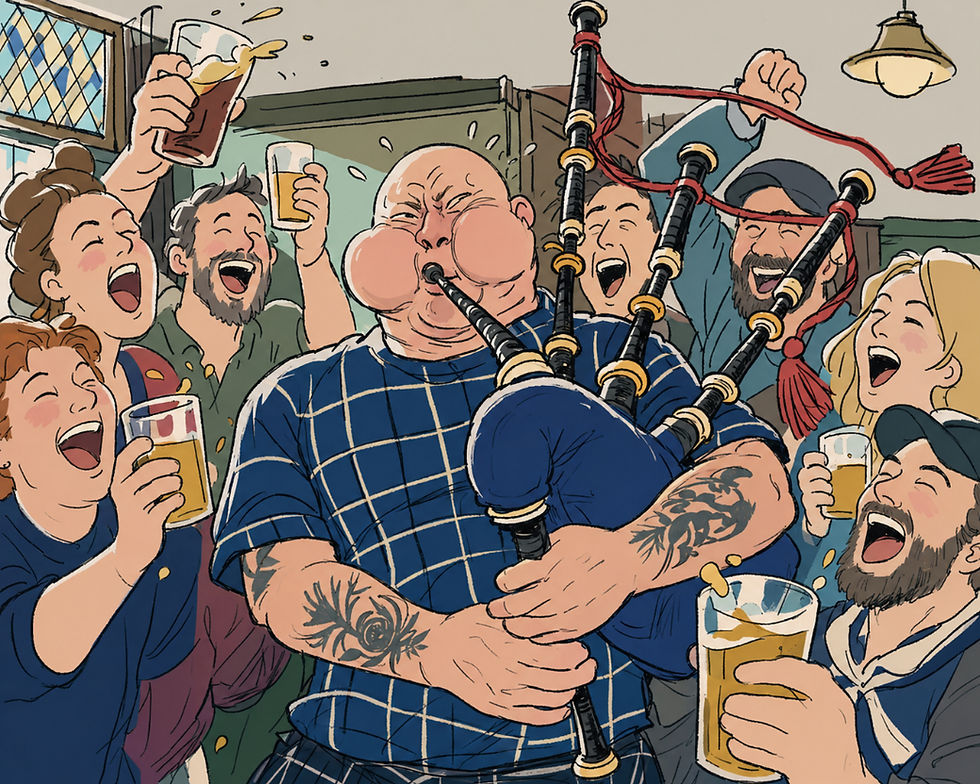
The Scottish fans came to Boston with kilts, bagpipes, and a serious commitment to beer. Their joy was so contagious that, for a few weeks, many Bostonians seemed to discover they were Scottish too.
They marched together. They drank together. They put traffic cones on things that probably did not need traffic cones.
By the end, Boston and Glasgow had turned the whole strange friendship into a symbol of connection, complete with a shared traffic cone and the words “No Boston, No Party.” The cone will now help raise money for mental health organizations in both places. Apparently, relationships can begin anywhere.
Even on top of a statue.
But my favorite edge moment happened after Norway beat Brazil.
The Norwegian supporters gathered for their Viking Row, crouching together, moving their arms like oars, and building toward that great roar.
At the very edge of the Norwegian fan section, a few Brazilian supporters joined them.
They had just watched their country get knocked out. Some still had tears in their eyes. They were standing right at the border between one group’s joy and another group’s heartbreak.
And they rowed together.
They did not stop loving Brazil. They did not pretend the loss did not hurt. For a few minutes, they simply stepped across the edge and entered someone else’s celebration.
That may be what healthy edges allow us to do.
We do not have to give up who we are.
We just make enough room to meet.
Every ending feeds a beginning
After a fire, flood, or major disturbance, an ecosystem does not return all at once.
It comes back in stages.
Small plants arrive first. Other species follow. Over time, a new forest takes shape. Ecologists call this succession.
The World Cup has its own succession.
We watched some of the great players move closer to the end. Luka Modrić, Neymar, and Cristiano Ronaldo carried years of history onto the field. Every touch came with a quieter question behind it:
Is this the last time?
Then there are the players in their prime, like Kylian Mbappé and Erling Haaland, carrying the full force of who they have become.
And behind them, the next growth is already pushing through: Lamine Yamal, Jude Bellingham, and other young players who do not seem interested in waiting their turn.
There is something almost too perfect about the old photograph of a 20-year-old Lionel Messi bathing baby Lamine Yamal during a charity calendar shoot. Nearly two decades later, they meet in a World Cup final, one near the end of an extraordinary career and the other just beginning his own. Neither family could have known what the photograph would eventually come to mean.
Nature rarely leaves a space empty for long.
One generation does not simply disappear. It creates the soil for what follows.
Even the great predators need an ecosystem
Nature has its great predators, animals whose presence can shape an entire ecosystem.
But even a predator does not live alone.
Wolves need the pack. Trees trade resources with fungi beneath the soil. Flowers depend on insects. Coral reefs are built through thousands of relationships that are easy to miss if you only look at the largest animal.
Soccer works the same way.
A superstar can change a match, but no player can press, defend, create, finish, and carry the emotional weight of a nation alone.
At times, Portugal seemed unsure how to fit Cristiano Ronaldo into the life of the whole team. His greatness was never the question. The relationship was.
Argentina has done something different with Messi. The team revolves around him, but it also holds him up.
Teammates run so he can conserve energy. They protect space for him. He finds passes that help them become more dangerous. The relationship moves in both directions.
Messi is the brightest tree in the forest.
But there is still a forest.
Individual talent can win a moment. Trust between people gives that talent somewhere to live.
In the end, we remember the relationships
When the tournament is over, I will remember some of the goals.
Sidny Lopes Cabral curling an impossible shot into Argentina’s net, then running into the stands to find his girlfriend because the feeling was too large to carry alone.
I will remember Cape Verde goalkeeper Josimar “Vozinha” Dias, a 40-year-old who became an unlikely star while his mother struggled to get a visa to watch him play. The world saw a goalkeeper making impossible saves.

Behind him was a son, a mother, grandparents who helped raise him, and a small country seeing itself on the largest stage.
I will remember a son comforting his father after a heartbreaking loss. Neymar and Ronaldo facing the kind of grief that comes when part of you knows it may be time to say goodbye. Fans crying for people they have never met.

And I will remember Cabral climbing into the crowd.
Not toward a camera.
Toward someone he loved.

Our relationship with nature works this way too. “The environment” is easy to ignore because it sounds like something far away. But a particular tree is harder to ignore. So is the bird that returns to the same feeder. The trail where we walked with someone we miss. The patch of woods where our children learned to be brave.
Care begins when nature stops being scenery and becomes kin.
Soccer is not just the relationship between a player and a ball. It is the relationship between teammates, between a team and its supporters, between parents and children, between countries, and between each of us and the game itself.
By the end of the Argentina and Cape Verde match, I found myself with tears in my eyes. I think I was trying to hold three things at once: the courage to keep fighting when no one expects you to win, the urgent need to share an unimaginable moment with the person you love, and the sorrow of an entire people carrying a loss together.
Maybe that is why we watch. The score tells us who won. The relationships give all that feeling somewhere to go.
For 90 minutes, there was a connection.
Soon the final whistle will blow. Someone will lift the trophy. Someone else will stand nearby trying not to watch.
The next morning, there will be no match.
My wife will be relieved.
I will probably go outside.
After watching the whole world run around a field for more than a month, it may be time for me to move a little too.


Comments